
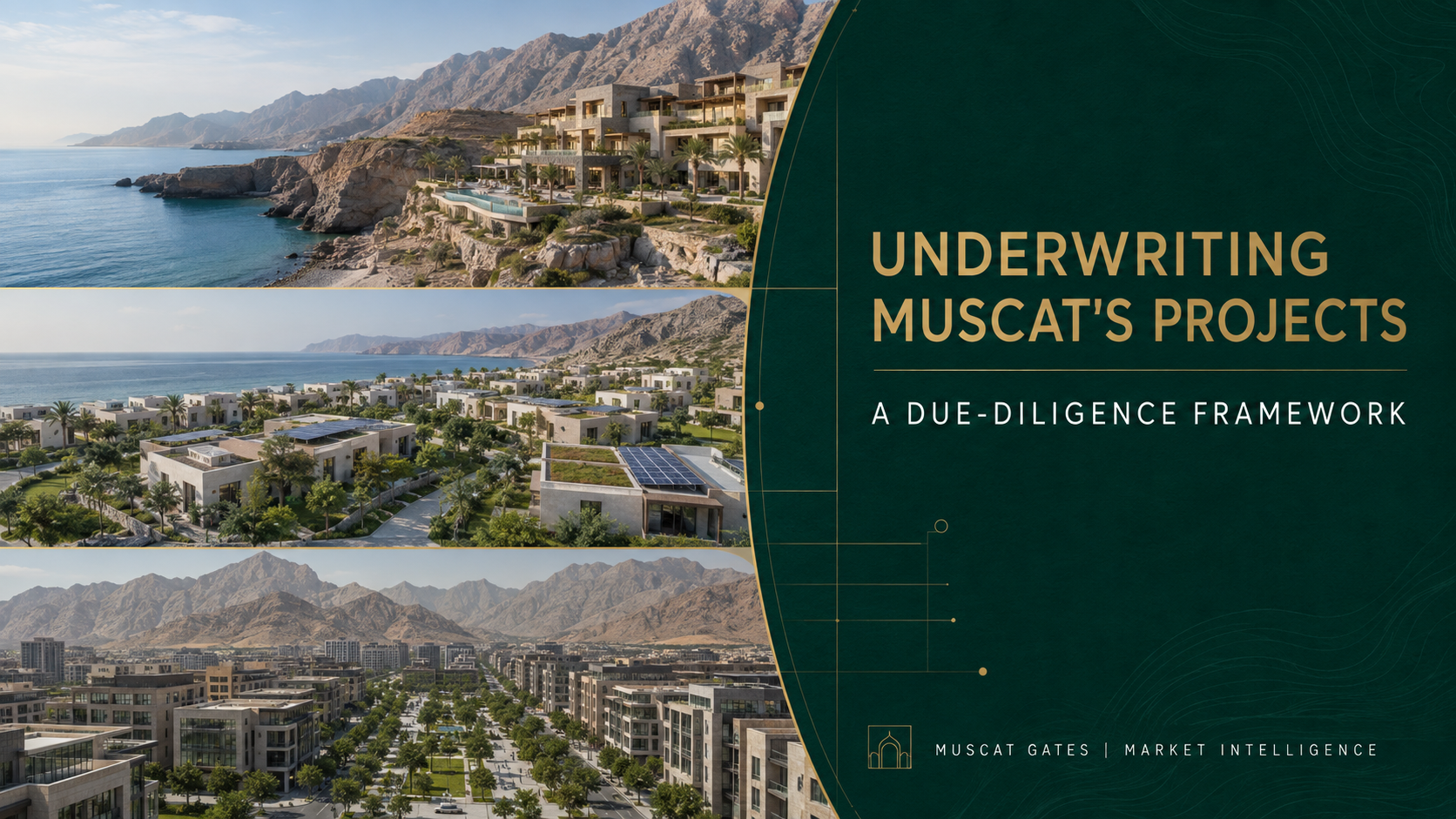
Muscat’s project pipeline is becoming more diverse. Cliffside resort
communities, net-zero coastal developments and a new metropolitan-scale
city can all appear under the same search term: “property investment in
Oman.” Financially, they are not the same product.
The right question is not which development has the strongest
presentation. It is which combination of delivery risk,
operating demand, legal title, recurring cost and exit
liquidity fits the investor’s mandate.
This article applies an investment-committee lens to three different
project archetypes: AIDA, The Sustainable City
– Yiti and Sultan Haitham City. It does not
rank them or recommend a particular unit. The purpose is to show how
evidence should be assembled before capital is committed.
Three
projects, three different investment exposures
AIDA: destination
and branded-demand exposure
DarGlobal and OMRAN announced AIDA as a mixed-use development in Yiti
and Yankat, approximately 20 minutes from central Muscat. The original
partnership announcement described a 3.5 million m²
site, 3,500 residential units, three development stages
and planned investment of SAR 6 billion.
An AIDA acquisition is therefore not simply a Muscat apartment
purchase. Depending on the phase and product, the investor may be
underwriting a combination of destination formation, developer delivery,
hospitality demand, brand positioning and international resale.
Key diligence questions include:
- What has been completed in the buyer’s exact phase—not elsewhere in
the masterplan? - Which amenities are legally committed, and which are
aspirational? - What are the brand, rental-program and operator agreements?
- Can the owner self-manage, appoint another manager or withdraw from
a rental pool? - How are service charges set after handover?
- Which buyer segment is expected to provide resale liquidity?
The strongest view or brand can support pricing, but it cannot
substitute for enforceable delivery obligations and a realistic
operating model.
The
Sustainable City – Yiti: operating-efficiency and ESG execution
exposure
The project’s official website describes a master-planned beachfront
community targeting net-zero emissions by 2040. It
states targets of up to 100% of the city’s own energy demand
from renewable sources, 100% wastewater recycling and reuse,
100% waste diversion from landfill and electric mobility
infrastructure.
For an ESG-oriented investor, these are relevant design objectives.
They should be treated as targets to diligence, not as already-audited
operating results for every future unit.
The investment case should examine:
- the measurement boundary for “net zero”;
- who funds, owns and maintains the energy and water systems;
- expected utility savings after all community charges;
- certification, monitoring and annual disclosure;
- replacement reserves for sustainability infrastructure;
- whether ESG performance affects tenant demand or merely initial
pricing; and - the enforceability of completion and performance obligations.
An efficient home with high community costs may not outperform a
conventional home. Conversely, verified lower operating expenses and
durable tenant preference can strengthen long-term net income. The
result depends on delivered performance.
Sultan
Haitham City: infrastructure, absorption and urban-growth exposure
The masterplan designed by SOM covers 14.8 million
m², with more than 2.9 million m² of public
space and approximately 20,000 homes of
different types.
This scale creates a different thesis: infrastructure sequencing,
district formation, services, transport, population absorption and the
timing of commercial activity. Value can vary materially between
districts and phases, even within the same masterplan.
The investor should test:
- the unit’s exact district and phase;
- funded versus conceptual infrastructure;
- school, healthcare, retail and transport delivery dates;
- competing supply scheduled for the same period;
- the likely profile of owner-occupiers and tenants;
- restrictions on foreign ownership for the exact project; and
- the depth of the resale market before the city reaches
maturity.
A large public masterplan can support long-term value creation, but
scale also means absorption should be modelled carefully. “City-level
success” does not guarantee identical performance for every unit.
The ten-file due-diligence
room
Before paying a non-refundable reservation amount, an international
investor should build a data room containing at least these ten
files.
1. Legal title and buyer
eligibility
Obtain the master title, unit plan, approved foreign-ownership
status, sale and purchase agreement, off-plan registration evidence and
any usufruct terms. Confirm that the buyer—individual, fund, company or
family office—is eligible to register the interest being sold.
2. Escrow and use of funds
Verify the project escrow account and the legal controls on buyer
payments. Payment milestones should relate to documented construction
progress, not only calendar dates.
3. Developer and contractor
record
Review completed projects, delivery delays, defect history,
litigation, financial capacity and the identity of the main contractor.
A global brand and a local construction counterparty may carry different
obligations.
4. Construction and
completion evidence
Ask for dated progress certificates, consultant reports, permits and
the contractual definition of completion. Model a delay even when
construction is visibly active.
5. Full acquisition cost
Oman’s government portal lists a charge equal to 3% of
property value for ownership in tourist complexes, plus
administrative fees. The total cost model should also include legal
review, finance charges, fit-out, furnishing and any applicable tax.
6. Service-charge budget
Obtain a written budget per square metre and identify what it
excludes. Stress-test the budget by at least 15–25% during early
operations, when occupancy may be below stabilised levels.
7. Rental evidence
Use executed leases or verified comparables—not asking rents.
Separate long-term residential rent from short-stay gross revenue.
Deduct vacancy, platform fees, management, utilities, cleaning,
maintenance, replacement reserves and seasonality.
8. Supply and absorption
Map competing units with similar price, size, delivery date and
target tenant. A project can be excellent while a specific unit type is
oversupplied.
9. Exit mechanics
Document assignment rules before completion, developer consent,
transfer fees, right-of-first-refusal clauses, resale commission and the
expected time to sell. Liquidity deserves its own discount rate.
10. Tax, succession and
repatriation
Oman’s VAT treatment varies by property use. The Tax Authority guide
identifies a 5% standard rate, while residential categories receive
different treatment depending on whether the transaction is a first
supply, resale or rental. Cross-border investors should also review
home-country tax, succession and reporting obligations.
Build the
return from cash flows, not from a brochure
Gross yield
Annual contractual rent ÷ purchase price
Useful for an initial screen, but incomplete.
Net operating yield
(Rent − vacancy − service charges − management − maintenance
− insurance − leasing cost) ÷ total acquisition cost
This is the more relevant measure for comparing units.
Levered equity return
Add financing cost, amortisation, arrangement fees and refinancing
assumptions. Because the Omani rial is pegged at USD 2.6008 per OMR,
US-dollar investors have lower translation volatility than non-dollar
investors, but borrowing costs remain sensitive to US monetary
conditions.
Exit IRR
Use a conservative sale price, explicit selling costs and a realistic
marketing period. Do not use developer list-price growth as evidence of
transacted appreciation.
A neutral scorecard
for comparing projects
| Dimension | Evidence required | Red flag |
|---|---|---|
| Legal title | Registrable right confirmed in writing | Ownership described only verbally |
| Delivery | Certified progress and enforceable long-stop date | Amenities or timing remain discretionary |
| Demand | Executed leases or defensible tenant research | Yield based only on short-stay listings |
| Operating cost | Detailed service-charge and reserve budget | “Estimated later” or materially incomplete |
| ESG | Measured targets, governance and reporting | Sustainability used only as marketing language |
| Liquidity | Comparable resales and clear transfer process | Exit depends on future developer buyers |
| Currency | OMR and base-currency model | Return discussed in one currency only |
| Downside | Delay, vacancy and price stress | Model assumes uninterrupted appreciation |
Different
investors should ask different questions
US-dollar investors
The OMR–USD peg simplifies currency reporting, but investors should
focus on financing cost, project liquidity and the relationship between
local income and global portfolio risk.
European investors
EUR or GBP performance may diverge from OMR performance. Model
translation risk and compare Muscat’s net yield and liquidity with
alternative euro- or sterling-denominated assets.
African investors and
family offices
The OMR can provide hard-currency diversification relative to some
domestic currencies. That benefit should be evaluated alongside
cross-border transfer rules, home-country reporting, governance,
succession planning and the ability to exit without relying on a single
buyer channel.
Professional asset managers
Require auditable data: title documents, escrow evidence, comparable
leases, operating budgets, construction reports and a quarterly
asset-management plan. If the evidence cannot be placed in an
investment-committee pack, the asset is not yet institutionally
underwritten.
What would invalidate
the investment case?
Every acquisition memo should define pre-commitment and
post-commitment stop conditions. Examples include:
- ownership eligibility cannot be independently confirmed;
- buyer payments do not enter a verified escrow structure;
- material amenities are not contractual;
- service charges exceed the downside model;
- net yield falls below the investor’s hurdle rate;
- delivery moves beyond the long-stop date;
- the rental strategy depends on an unlicensed or restricted use;
or - the projected exit requires appreciation unsupported by completed
transactions.
Conclusion:
project selection is mandate selection
AIDA, The Sustainable City – Yiti and Sultan Haitham City represent
different forms of exposure: destination and brand formation;
sustainability and operating execution; and infrastructure-led urban
growth.
None is inherently the correct choice for every international
investor. The correct asset is the one whose legal structure, cash-flow
profile, delivery risk and exit market match the investor’s mandate—and
remain acceptable under a downside scenario.
Muscat’s strongest investment opportunities will not be identified by
the most optimistic yield. They will be identified by the
highest quality of evidence per rial invested.
Sources and methodology
- DarGlobal
— AIDA partnership and masterplan announcement - The Sustainable City
– Yiti — Official project website - SOM —
Sultan Haitham City masterplan - Gov.om —
Ownership in Tourist Complexes - Central Bank of
Oman — Fixed Peg of the Omani Rial - Oman
Tax Authority — VAT Guide for Real Estate
This article is educational market commentary and does not
constitute investment, legal, tax or residency advice. Project claims
are attributed to official developer or government sources and should be
verified against current contracts. Data were checked on 30 August
2026.